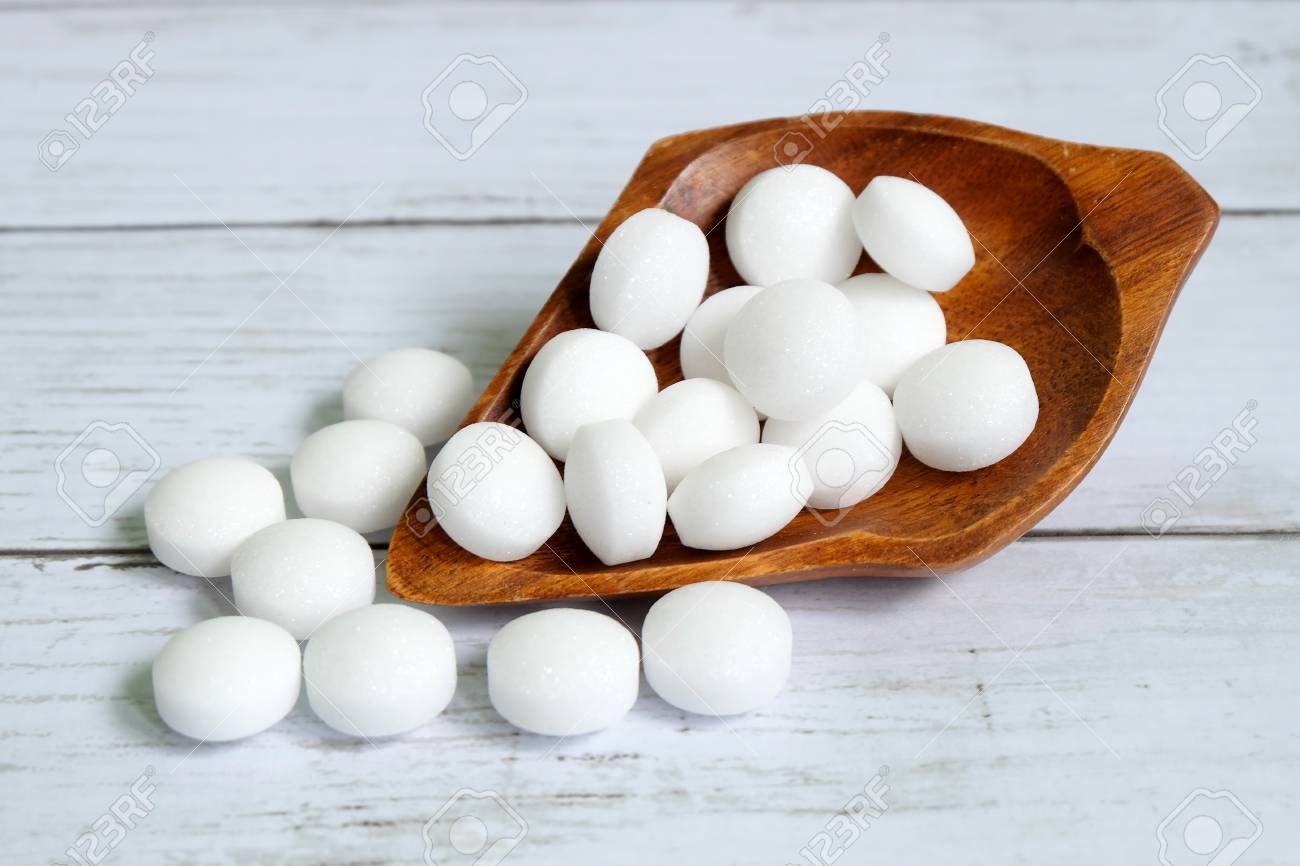
Napthalene, those white, tablet shaped balls with an amazing smell (Well, atleast for me) have been used for many years to keep insects like cockroaches and moths away. Just toss some into a closed area and it will be insect-free until the ball sublimes. However, not many know as to why this substance has insect repellant properties. This is our topic for today.
Napthalene is a hydrocarbon i.e. it is completely made of carbon and hydrogen. Its chemical formula is C10H8 . It has the property to sublime i.e. to convert to the gaseous state from the solid state, bypassing the liquid state (If you want to know why substances sublime, check this article of mine- https://pcbpedia.home.blog/2019/10/19/why-do-substances-sublime/).
Napthalene can kill humans too if they are exposed to it for a long time, or if they ingest it. Now, let us see why insects are repelled by napthalene.
Considering the example of a cockroach, they too have a respiratory system like we do. Now, the fumes that are emitted by napthalene tend to block a cockroach’s respiratory tract, also called as tracheae. These fumes tend to disrupt the metabolism of the cockroach and start to suffocate it. As a matter of fact, napthalene is also used in the manufacturing of PVC (PolyVinyl Chloride), which is a very durable type of plastic usually used in making plastic carry bags. So, you can imagine how poisonous it could potentially be. In certain species, it is even known to be carcinogenic (cause cancer).
So, as the cockroach knows it is poisonous and that it might suffocate, it stays away. However, if it is trapped, it will succumb to the fumes, though we rarely see cockroaches lying dead near napthalene.
Coming to the other effects of napthalene, it has been known to cause a variety of dosorders like haemolytic anaemia, jaundice, nausea, diarrhoea among others.
So, how was it? Did it make you throw napthlene balls all over the place? Feel free to comment in the Comments section down below.
Stay Home, Stay Safe!
Note: This might be my shortest article I have written. Don’t worry, as longer articles are on the way.
Mercury has been one of the most mysterious elements (well, atleast for me). Not only is it a bad conductor of electricity, has low melting and boiling points, and extremely unreactive, unlike most metals, it is the only liquid metal. Today, in this article, we shall see as to why mercury is a liquid.
Courtesy: PubChem
Predominantly, we shall be focusing on the fact that mercury is a liquid whereas all the other elements surrounding it (Cd- Cadmium, Ag- Silver, Au- Gold, In- Indium, and Tl- Thallium) are all usually found in their solid states. Moreover, the elements belonging to the same group (column) as mercury, which include zinc and cadmium, should have similar properties to mercury. However, they differ in their state there. So, what is the cause of this difference?
First, we have to inspect the electronic configuration of mercury. The electronic configuration refers to how the electrons in an atom are arranged in different levels (called shells) in an atom. Each shell can hold a specific amount of electrons. According to that, mercury’s electronic configuration would be as follows:
2,8,18,32,18,2
I will not be going over how this arrangement came into existence as it requires some advanced knowledge of Chemistry (however, if you are curious, check out the concepts of Bohr’s Atomic Model). Now, we shall try to establish a link between the way electrons in mercury are arranged and the state of mercury.
Now, if we go deeper into mercury’s electronic configuration, we get:
You don’t need to bother about how this came into existence too (however, if you are curious, check out the concepts of atomic orbitals, quantum numbers, and filling of orbitals.)
Now, if you observe the configuration I wrote, the highest number you see is in 6s2 . This highest number indicates that electrons have been filled in 6s at the last. Now, ‘s’ indicates a small area inside a shell, which can hold atmost two electrons. That means that 6s has been filled, as it has two electrons, evident from the fact that 2 is written above it. This is where the reasoning comes.
There are now several reasons to mercury’s nature, I will go over them one at a time.
Firstly, as I have already told you that 6s is filled with 2 electrons, all the others ‘ones’ like 4f, 5s, 5d etc. are also completely filled. This gives mercury an unusually high stability. Now, the mantra of most atoms in chemistry is to combine and become stable. However, mercury is already stable. So, the atoms of mercury don’t form any ‘bonds’ (Bonds are attractive forces between atoms which are formed to gain stability) with other adjacent mercury atoms. So, the atoms in the structure tend to remain loose and make mercury liquid in state.
The previous paragraph was probably the best way to explain this phenomenon. Secondly, certain relativistic effects give mercury its characteristic nature. To put this effect in simple words, let us visualize an atom:
Now, in this image, the green circles are the electrons and the blue-pink region is the nucleus. The electrons have a negative charge and the nucleus has a positive charge. Now, it is natural for the nucleus to attract the electrons. Moreover, the 6s area I talked about earlier is very far away from the nucleus (The 6 in 6s indicates that it is 6 levels away from the nucleus. That distance is very far for an atom.).
However, due to high speed revolution, it tends to come closer to the nucleus quite often, which also increases its mass due to high attractive forces. So, this 6s area tends to be bonded closely to the nucleus, which is known as the ‘relativistic contraction’, as the 6s area has contracted by coming closer to the nucleus as compared to other ‘areas’ like 4f, 4d etc..
Now, unfortunately (Or fortunately, however you would rather take it), the two electrons in the 6s area are the ones which mercury uses to form bonds. Now, if those electrons are held tightly by the nucleus, there is no chance for them to form bonds. So, the atoms remain non-bonded and distant from each other, Oh, and if you were curious as to what the ‘area’ in ‘6s area’ refers to, it refers to the ‘6s orbital’, which is just a 3D space where electron are present in an atom.
Finally, an effect called the screening/shielding effect. Now, considering the below image, where I have (tried and) shaded an electron in red for better understanding.
We know that the nucleus will attract the red electron as unlike charges attract (If you didn’t know this, time to go back to school for you!). However, the adjacent electrons will start to repel the red electron as like charges repel each other. Now, due to sheer abundance of electrons, the force the nucleus exerts on the red electron will be reduced considerably due to the adjacent electrons’ force cancelling some of it out. This effect is known as the screening/shielding effect. It is usually used to identify exceptions in the usual trend of elements.
Now, contrary to this, the orbitals in which the electrons are in do not show this effect to a great extent for mercury. Due to this, the electron are bounded to the nucleus and are not allowed to react. This too makes the structure loose and liquid.
I suppose this article introduced you to a lot of different terms of what we call ‘quantum mechanics’. Don’t worry if you didn’t get some parts of it (or any part of it, for that matter), as a famous physicist, Richard P. Feynman, once said – “If you think you understand quantum mechanics, then you don’t understand quantum mechanics.” Quite contrary, right? I’ll leave you there, until my next article. Until then, Stay Home, Stay Safe.
Almost everyone must have seen the periodic table of elements at least once in their life. For some, it is very appealing and for some, a massive headache. However, a question not many of us get is why the periodic table is shaped in this way. Instead of making it so absurdly irregular in shape, why not make it like this?
Don’t mind my editing skills. They are quite bad.
Now, the above edited one looks more properly shaped. However, this does pose a challenge for chemists who refer this table almost every day. We shall now discuss the reasons for the irregular shape of the periodic table.
First, let us consider hydrogen and helium. They are quite out of place, above the rest of the table. The reason being that these two elements show anomalous behaviour. Going in detail, we see that hydrogen has only one electron with it. In that sense, it should belong to the first group of the table (first column). However, hydrogen can combine with itself to form a H2 molecule. This is a characteristic feature of the group 17 elements (from fluorine to tennessine). So, due to this, hydrogen was given a special spot in the table.
Coming to helium, we see it has two electrons with it. Now, it should technically be in group 2 (beryllium to radium). However, it is very unreactive, as opposed to the group 2 elements which are quite reactive. So, it is placed under group 18 (noble gases).
Now, let us focus our attention to the BIG wide gap in the middle of the periodic table. Specifically, the gap from group 3 to 12. Now, these elements are called transition elements. They exhibit properties which don’t really match with the other two sides of the periodic table (sides referring to group 1-2 and group 13-18). Thus, they have their own special area.
Now, the last point of our discussion will be the last two rows at the bottom of the periodic table. The first row is called the ‘lanthanides’ and the second row is called the ‘actinides’. These are, by far, the most complex elements to study as they follow no particular trend. Their properties can not be estimated and must be found out experimentally. Moreover, they are highly radioactive and only some particles remain after the element’s synthesis. Their electronic configurations (the way the electrons in an atom are arranged) are different with each element. Thus, after element number 56 and element number 88, the lanthanoids and actinoids start respectively below the whole table.
Another extra thing I would like to talk about is the potential discovery of new elements. Suppose, we find an element which comes after element number 118. Where would we place it? Now, the most appropriate place for now would be below francium in group 1. However, it highly depends on the element’s properties, as all elements after uranium are radioactive and may differ in characters.
So, how was it? Did it make you reach out for the periodic table? Feel free to comment in the Comments section.
When something is lit up, it almost immediately catches fire. Some substances like sodium catch fire without the help of any external source while substances like wood take a lot of heat to catch fire. However, some substances do not burn with a flame, a popular example being coal. But, why does it burn without a flame?
Before we dive deeper, two concepts should be clear- Volatile and Non-Volatile Substances.
Volatile substances are the substances which convert to vapours at the current surrounding temperature and pressure conditions. A popular example is petrol.
On the other hand, non-volatile substances are those which do not convert to vapours at the prevailing temperature and pressure conditions in the surrounding.
A substance will only produce a flame when the substances present in it are volatile. This statement is explained in detail below.
When we burn something, it gets heated up. The substances trapped inside the combustible thing also get heated and, if they are highly volatile, they vaporize and catch fire with the help of the atmospheric oxygen. Thus a flame is produced.
On the other hand, if the substances are non-volatile, the combustible thing will only get heated but will not produce any flame.
So, how was it? Did it heat you up so much that you caught fire? Feel free to comment in the Comments section.
Almost everyone of us must have experienced the phenomenon of sublimation, be it the disappearing case of naphthalene balls without a trace or the magical effects of dry ice in a theatrical performance. Sublimation is defined as the conversion of a substance from its solid state to its gaseous state without passing through the liquid phase. But, why do substances sublime?
Before I answer this, let me give you a brief background. To convert any substance from one state to another, two factors play a pivotal role: temperature and pressure. If temperature is increased, state change happens from solid to liquid to gas but if pressure is increased, state change happens from gas to liquid to solid.
For this discussion, let us consider dry ice (solid CO2 ). Carbon dioxide exists in its solid state at -78.5°C, which is way below that of water (0°C). At STP (Standard Temperature and Pressure), carbon dioxide exists as a gas.
I would like to clear one thing here- Liquid CO2DOES exist. The only factor that makes it impossible to naturally obtain liquid CO2 is pressure. CO2 exists as a liquid at a pressure condition of 5.1 atm (atmospheric pressure) and temperature between –56.6 and +31.1°C. Though the temperature can be naturally obtained on Earth, the pressure of 5.1 atm is impossible to obtain naturally. The Earth’s atmospheric pressure is 1 atm. So, to obtain liquid carbon dioxide, we need to quintuple the atmospheric pressure! That wouldn’t be the best thing to do as it would affect all organisms adversely.
Similarly, any sublimable substance (ammonium chloride, naphthalene, camphor, iodine) would not be able to exist in liquid form due to unfavourable pressure conditions (naturally, that is).
So, how was it? Feel free to comment in the Comments section.
It is a known fact that every element on the periodic table is reactive (only excluding some of the noble gases and noble metals). But, can two metals be equally reactive?
Instead of going all theory, let us consider an example. Suppose there are two elements X and Y. X is in its free state while Y is in the form of a sulphate, say YSO4. Let us assume both X and Y to be equally reactive. So, what would happen to the reaction?
Let me brush up some chemistry facts right now. Firstly, let us depict the reaction as follows:
If X is more reactive than Y, the products of the reaction would be XSO4 + Y. But, if Y is more reactive than X, no reaction will take place.
Now, to the main point. In reality, it is not possible for two elements to be equally reactive. This fact is explained below.
We all know that all atoms of elements have electrons revolving around the nucleus. The fact of the matter is that all atoms have different amount of electrons i.e. no two atoms have the same number of electrons (We exclude isoelectronic species). But, one might also say that only the valence electrons (Electrons which revolve in the last shell of the atom) take part in the reaction. This is true. Furthermore, there are more than one elements having equal number of valence electrons. So, how do we resolve this dilemma?
For this, let us consider another example. Carbon and Silicon both have 4 valence electrons. So, they should be equally reactive. No! Not at all. Firstly, let us consider their atomic structures.
From this, we see that in carbon, there is only one shell before the valence shell (the shell which carries valence electrons). However, in silicon, there are two shells before the valence shells. Thus, there is a stronger force of electrostatic attraction between protons and electrons in silicon compared to carbon, making it more difficult to remove electrons in the former than the latter.
There is one more explanation to this question. We know that elements in the periodic table are arranged according to their reactivity (Reactivity reduces as one moves from left to right in the table). So, if two elements had to be equally reactive, they would have to coincide on the periodic table, which is not possible.
So, in conclusion, it is not possible for two elements to be equally reactive. However, what if an element was made to react with its own kind, like Iron (Fe) reacting with Iron (II) sulphate (FeSO4)? That’s a question for another article!!
So, how did you feel? Did you get the sudden itch to study the periodic table even more? Feel free to comment in the Comments section.
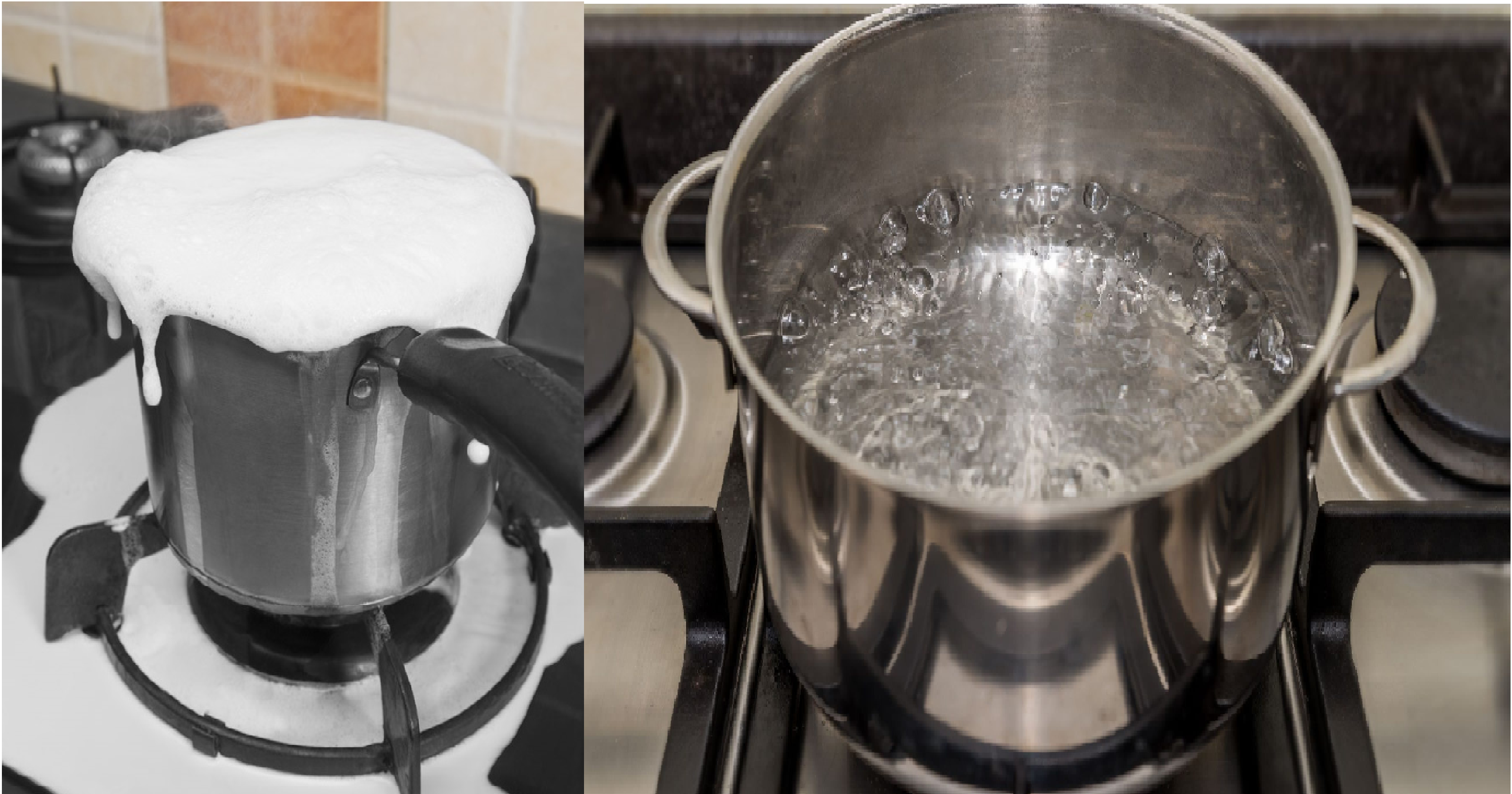
Almost all of us must have gone through the pain of wiping our stoves after some boiling milk overflowed upon it. Some might have also wondered why milk overflows but water, another liquid, doesn’t. This is today’s topic of discussion.
Evidently, the composition of water and milk is different. Water is made up of H2O molecules, which makes it a true solution, while milk is made up of oils, fats, water, proteins and lactose to name a few, making it a “colloid” (A substance which contains large molecules of one substance dispersed in another). Now, after studying their composition, let’s go to the main point.
When we boil milk, the water molecules present within the milk get heated up and convert into their gaseous form. As gases tend to rise, the water vapour slowly makes its way up. However, it is obstructed by a layer made up of fats and oils. This layer exists at the very top of the milk. In order to escape, the water vapour pushes the layer up, causing it to rise and potentially spill. The water vapour then escapes into the atmosphere.
A point to note is that if the same milk is boiled again, it will not overflow as it no longer contains water.
It must have become obvious why this phenomenon doesn’t happen in water. As water is a true solution, no layers are formed or particles don’t settle down. So, when water converts to vapours, it freely escapes into the air.
So, how was it? Did it make you rush to the fridge to grab yourself some milk? Feel free to comment in the Comments section.


 pcbpedia