Tired of waiting for another article? Wait no more. A new article is on the way…….. On 1st September 2019…..
If Torches Emit Light, Can Something Emit ‘Dark’?
(Please note that this article is not based on proved facts. It is just a theory.)
Whenever the power goes off, we rush to get a torch, which immediately fills light in the midst of darkness. But, what if there was a device that could produce ‘dark’ in the midst of light? Creepy, huh?
Almost everyone must of heard of anti-matter – matter that is made up up anti-subatomic particles. Anti-matter consists of anti-protons (which carry a negative charge), anti-electrons (also called positrons – carry a positive charge), and anti-neutrons (which carry no charge). If someone were to combine antimatter and matter, a very large amount of energy would be released.
Now, if light contains photons, can’t “anti-light” (or ‘dark’) contain anti-photons? Though highly possible theoretically, it doesn’t seem very practical. We know that photons emit energy. So, “anti-photons” should emit “anti-energy”. This is definitely a weird topic to grasp and that is why is it just a theory. But, just in case we do shine a ‘dark’ (I suppose you get what I meant), what would we see?
In simple terms, nothing! Wherever we shine the ‘dark’, we would just see a black spot. That black spot is actually a black hole (Black holes are the remnants of massive stars which form in the Universe. The gravitational strength of a black hole is so strong that not even light can escape. So, they are basically invisible to our eyes) because it is a place where no light exists! So, creating a black hole on Earth wouldn’t be the best thing to do.
So, in conclusion, if we somehow do manage to create a device that can emit ‘dark’, we must be ensure that it does not turn out to be a black hole. It should have particle and wave nature just like light and should have the physical properties of light.
So, how was it? Did it make your head spin and make you forget the difference between light and dark? Feel free to voice out your thoughts in the Comments section.
Author: Venkata Bhamidipati
Why Do We Yawn?

A yawn is something we get at a moment we least expect to. Be it a boring lecture or a monotonous meeting. But, why do we yawn? Is it a sign of something bad to happen? And why on earth are they contagious?
It is a known fact that all living organisms need oxygen to thrive on Earth. Oxygen facilitates metabolic activities in our body and helps in the release of energy to help us do work. However, when we do some work with less enthusiasm or energy , our breathing rate slows down. The brain signals the respiratory system that the levels of oxygen are low. The signal is then sent to the mouth to open up wide and take a deep breath so as to replenish the oxygen supply in one go. This act of ours is what we call yawning. An interesting thing to note is that this theory is one of almost 20 more theories on why we yawn. However, not one theory has been officially accepted.
Coming to the second question I left you at the beginning. Is it a bad sign to yawn? Well, though it is good for your body as it increases the supply of oxygen, it wouldn’t be good to yawn in someone’s face. That indicates that you have no (or negligible) interest in what they are saying.
Another point of discussion is why yawns are contagious? One person yawns, and a chain of yawners is created. This is due to a phenomenon called echopraxia, the automatic imitation of another’s actions. This phenomenon is found in many animals- chimpanzees, dogs etc.
So, how was it? Did it make you yawn (Hopefully, it didn’t)! Feel free to drop a comment in the Comments section.
Author: Venkata Bhamidipati
Source (Image): cbsnews.com/news/why-are-yawns-contagious-new-clues/
Why Milk Overflows But Water Doesn’t?
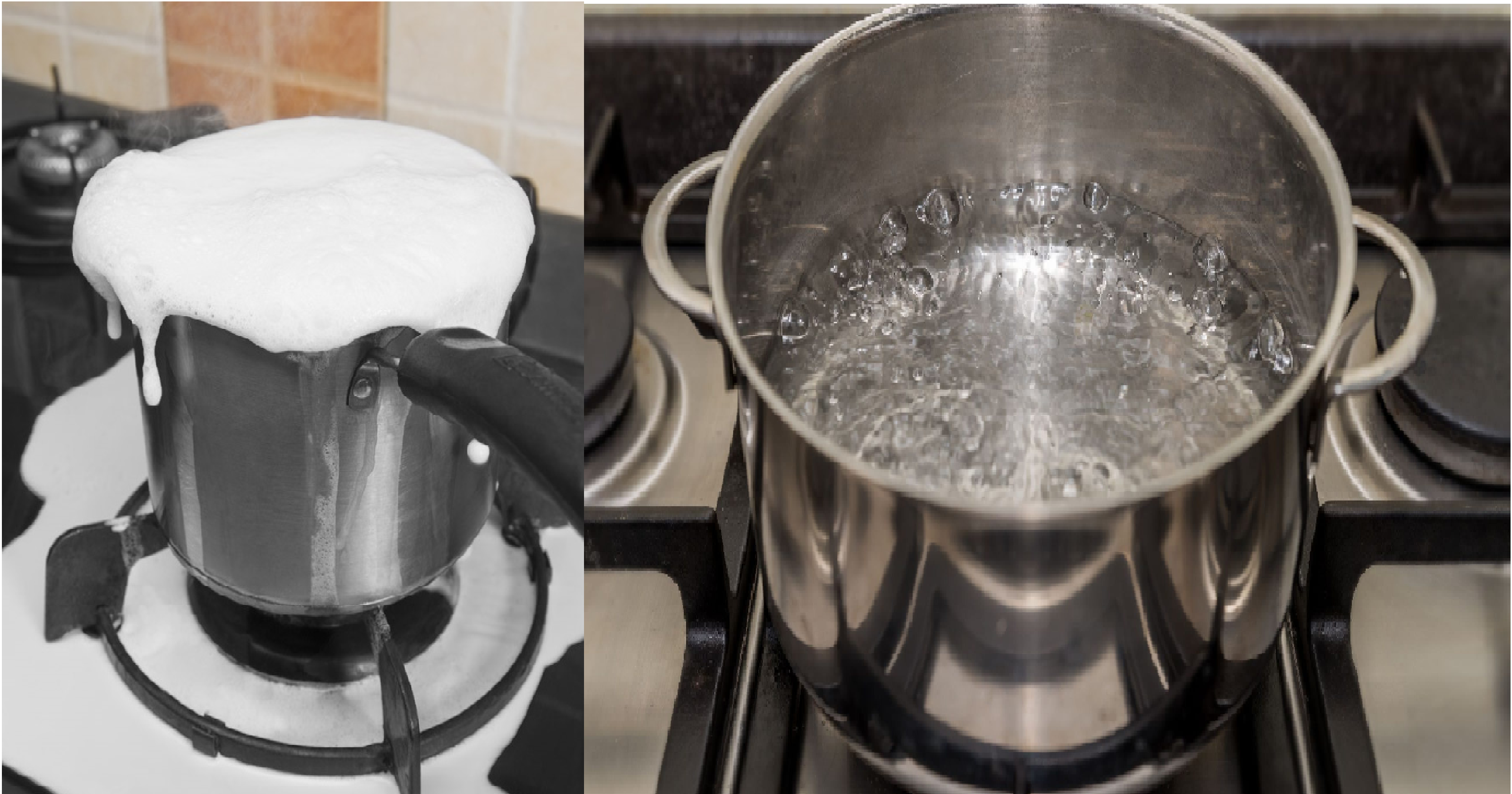
Almost all of us must have gone through the pain of wiping our stoves after some boiling milk overflowed upon it. Some might have also wondered why milk overflows but water, another liquid, doesn’t. This is today’s topic of discussion.
Evidently, the composition of water and milk is different. Water is made up of H2O molecules, which makes it a true solution, while milk is made up of oils, fats, water, proteins and lactose to name a few, making it a “colloid” (A substance which contains large molecules of one substance dispersed in another). Now, after studying their composition, let’s go to the main point.
When we boil milk, the water molecules present within the milk get heated up and convert into their gaseous form. As gases tend to rise, the water vapour slowly makes its way up. However, it is obstructed by a layer made up of fats and oils. This layer exists at the very top of the milk. In order to escape, the water vapour pushes the layer up, causing it to rise and potentially spill. The water vapour then escapes into the atmosphere.
A point to note is that if the same milk is boiled again, it will not overflow as it no longer contains water.
It must have become obvious why this phenomenon doesn’t happen in water. As water is a true solution, no layers are formed or particles don’t settle down. So, when water converts to vapours, it freely escapes into the air.
So, how was it? Did it make you rush to the fridge to grab yourself some milk? Feel free to comment in the Comments section.
Author: Venkata Bhamidipati
How Light Passes Through Glass?
Light passes through glass because glass is transparent. And why is glass transparent? Because light passes through it. This is the same old answer we get when we ask such a question. Let me tell you how this works:
We see objects because light falls on it. This is in the case of solids. In glass, which is a different state of matter on its own (a supercooled liquid, to be precise), the atoms are arranged in structures called lattices. When a ray of light falls on glass, the photon (the smallest particle of light) interacts with the electron in the atom of the lattice. As photon is a form of energy, the electron absorbs it and moves on to the next shell (imaginary paths in an atom). but, as electrons can’t stay in another shell for a long time, it re-emits the energy absorbed and the energy (basically the photon) moves on to the next atom, until it exits the glass medium.
Some might wonder as light passes through glass, shouldn’t it refract (bend)? Actually, it does. But, as our eyes can’t detect such phenomenon at a microscopic level, it seems to us that light passes in a straight line.
So, how was it? Did it “lighten” you up? Feel free to share your thoughts in the comments section.
Author: Venkata Bhamidipati
Why This Blog?
Hello to everyone who is reading this. I am Venkata and I am the owner of this blog. This blog was created in order to spread the vast amount of scientific knowledge present in this world. Anyone can pose a question in the comments section or ask for a post on a certain topic. This is going to be a community or a platform to share your views openly………. So, what are you waiting for?? Comment On!!!!!!!! Also, for your information, the ‘p’, ‘c’, and ‘b’ stand for ‘Physics’, ‘Chemistry’, and ‘Biology’ respectively.
 pcbpedia